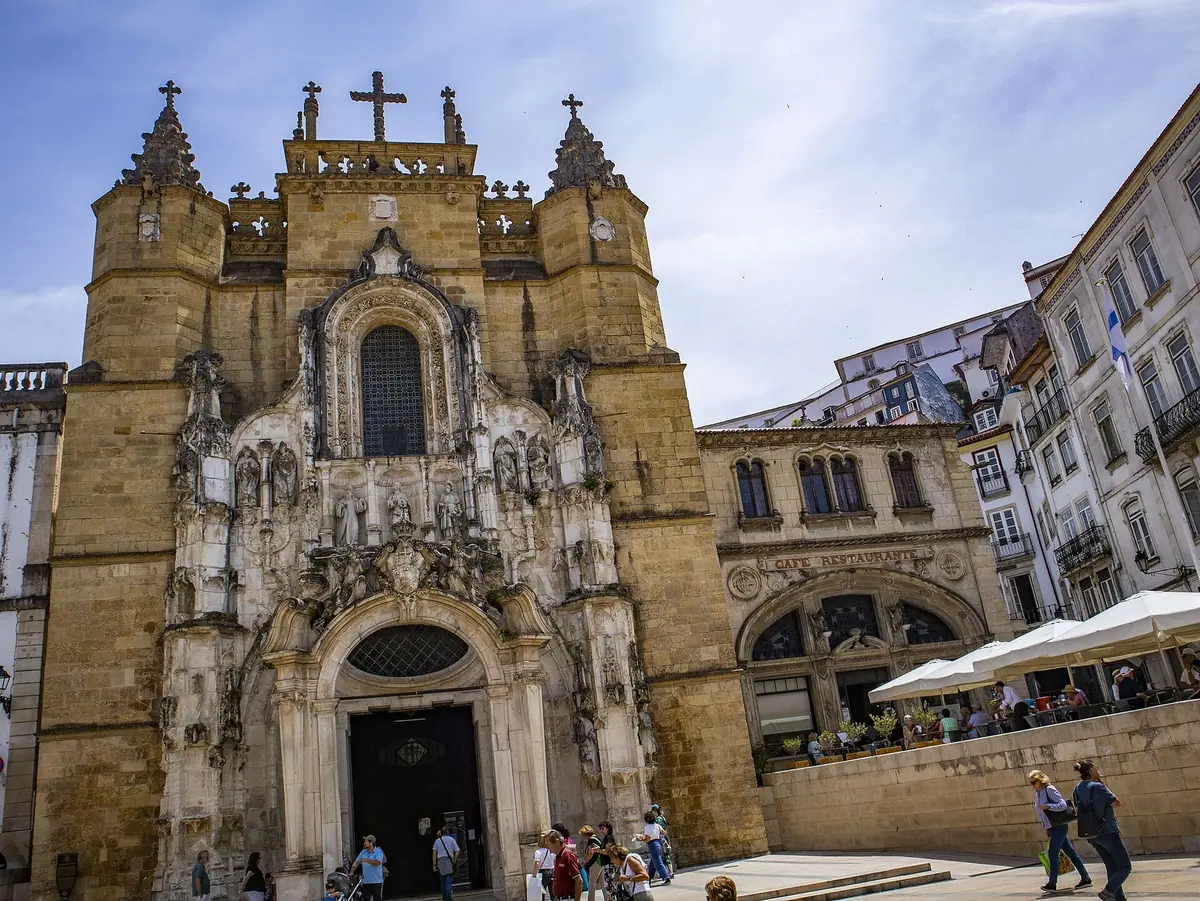

The square sounds like buses and a fountain. Then you turn to the north side and there is a carved stone facade that does not belong to the traffic in front of it — a tall Manueline screen, scrubbed pale, with a doorway under it. Push the door and the noise stops. Inside is a long vaulted nave with two royal tombs raised on either side of the altar. Portugal’s first two kings are in that room and you did not pay to come in.
This is Praça 8 de Maio, the head of the Baixa. The Mosteiro de Santa Cruz was founded in 1131 by Archdeacon D. Telo and his companions under the Augustinian rule; the adjoining Church of São João de Santa Cruz was completed in 1530 under King John III. The whole complex was classified a National Monument in October 1921. Treat this as a monument square that happens to have cafes on it, not as a neighbourhood with a monument in it.
The pantheon on the square
Santa Cruz holds the tombs of Afonso Henriques and Sancho I, the first two kings of Portugal, which makes it a national pantheon in the literal sense. They stand raised on either side of the high altar in the nave, and the nave costs nothing.
The 5.00 EUR ticket buys what most visitors walk past: the cloister, the sacristy and the high choir. Group rates run from 3.50 EUR each for twelve or more, and school groups pay 2.00 EUR per pupil. Published hours are Monday to Saturday 09:30–16:30 and Sunday 13:00–17:00.
Fifteen minutes in the free nave is a reasonable visit. An hour with the paid ticket is a better one, and the full account is on the Santa Cruz monastery page.
One block east, off Rua Olímpio Nicolau Rui Fernandes, stands the Jardim da Manga — the surviving fountain-and-pavilion structure from the monastery’s old garden, now with a restaurant in the same address book. It is a five-minute detour from the square and almost nobody makes it.
Look at the facade before you go in. What faces the square is a sixteenth-century Manueline screen applied to a much older church, and the joins are visible if you know to look for them — this building was remodelled by the Portuguese crown at the height of its wealth, over a foundation from the century Portugal was invented. The two royal tombs inside were part of the same programme: a dynasty rebuilding the burial place of its founders.
The café in the church
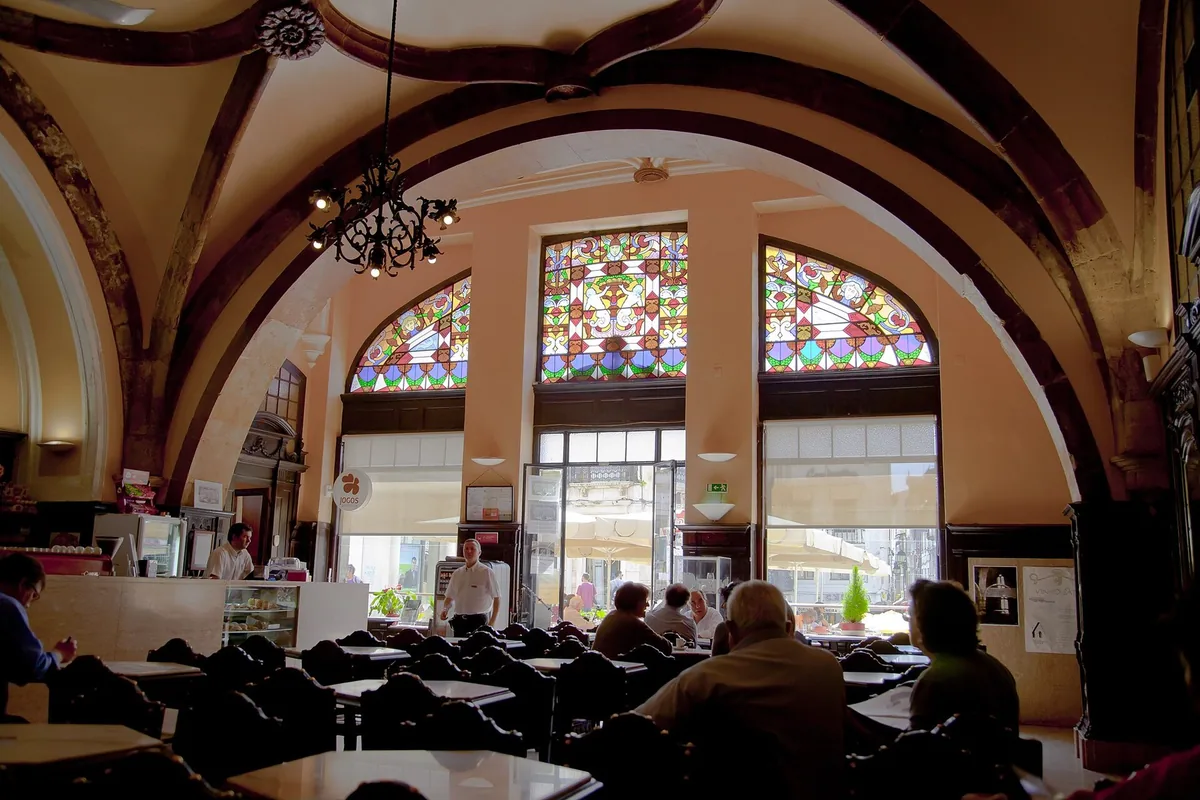
On the east side of the square, Café Santa Cruz occupies the former Church of São João de Santa Cruz, part of the same monastic complex. The short version you will read elsewhere — a café in a deconsecrated church — is true and badly incomplete.
The church was deconsecrated in 1834, when the religious orders were expelled after the Liberal Revolution. It then held assorted commercial uses for the better part of a century. The architect Jaime Inácio dos Santos presented renovation plans in February 1921, the building was classified in October of that year, and the café opened in 1923. There is an eighty-nine-year gap between the deconsecration and the first coffee, and most write-ups collapse it.
Since 2015 the café has been the headquarters of the Portuguese Association of Historical Cafes. It runs free Coimbra fado at 18:00 and 22:00 daily, with no 22:00 session on Sundays. Its own opening hours are not published anywhere we trust, including on its own site, so do not plan a tight schedule around them.
Inside, the documented fittings are worth naming: stained glass by the Almeida brothers and Afonso Pessoa, wrought-iron chandeliers by António Maria da Conceição, and original furnishings with marble tabletops and leather chairs. The house sweet is the Crúzio, made to a recipe of sweet egg and toasted almond and created in 2012 as a nod to the monastic heritage — the café’s own framing of that link, not a historian’s.
Rua da Sofia, the other half of the UNESCO listing
Running north from the square is Rua da Sofia, and it is the part of Coimbra’s World Heritage inscription that visitors skip. The 2013 listing is called the University of Coimbra – Alta and Sofia for a reason: this street was laid out as the university’s sixteenth-century college quarter, and the colleges are still standing along it.
It does not perform. It is a working street with traffic, shopfronts and a row of very large religious facades set into ordinary blocks. That is the interest of it. Walk five minutes up and five minutes back before you decide it is nothing.
It is also an eating street with its own addresses — Restaurante Cova Funda at Rua da Sofia 117 among them. If the Baixa lanes are full on a Friday, walk north instead of south.
How to use the square
Practical honesty: Santa Cruz is not a place to stay. No reliable source describes it as a residential quarter with its own character, nightlife or hotel stock, and we have not found one. It has no accommodation entries in this guide and that is not an oversight.
What it is, is a hinge. It sits at the top of the Baixa shopping spine, ten flat minutes from Largo da Portagem and the river, and the stepped climb to the Alta starts a few streets south under the Arco de Almedina.
The best use of it is a bookend. Do the hill in the morning, come down, and give the square the late afternoon: free nave, paid cloister, a table outside the café, and the 18:00 fado without a ticket. That sequence is the cheapest good evening in Coimbra.
For the hill-and-square combination as a single walking route, follow the Alta to Baixa descent, which finishes within sight of this facade.