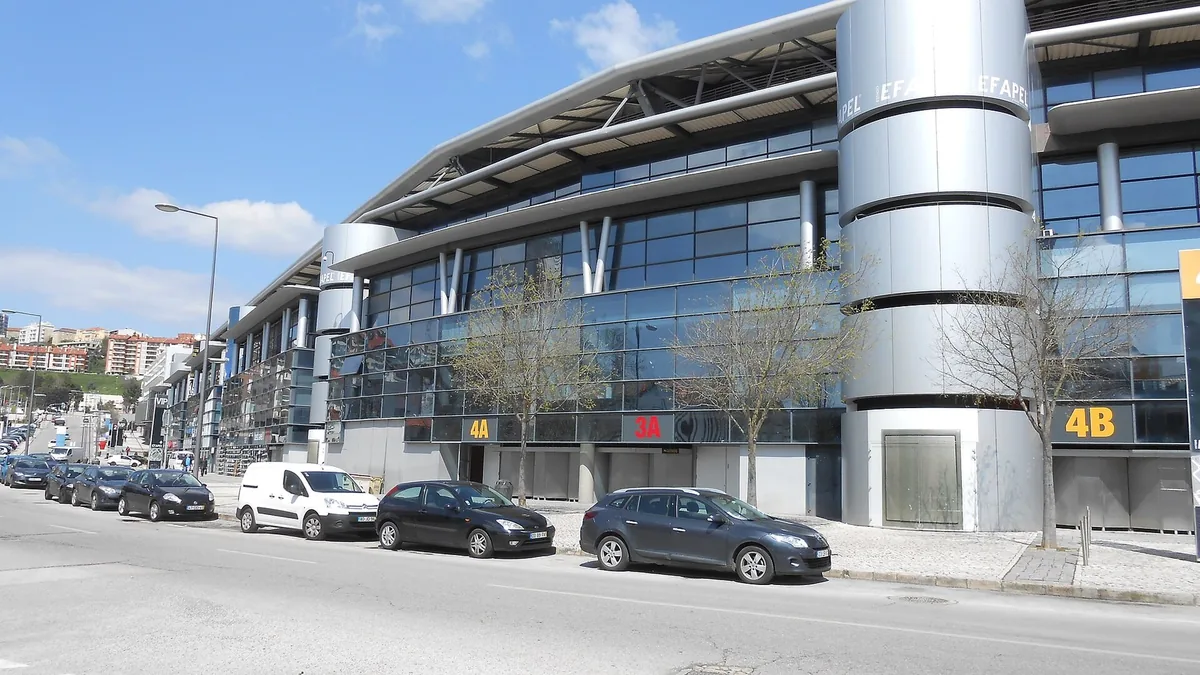

Solum looks like the part of a Portuguese city that nobody photographs. Apartment blocks with balconies, wide pavements, a supermarket trolley bay, trees planted in rows at the same time as the buildings went up. There is no cobbled lane, no stepped alley, no facade older than the twentieth century. If you arrived expecting Coimbra to be the hill all the way through, this is where the city corrects you.
Turismo de Coimbra, the official tourism body, describes Solum as an area for people seeking quality of life in a well-structured urban environment, and says it draws families and young professionals on the strength of its shopping, green space and food. That is the official framing, and it is honest about what the district is: a place to live rather than a place to sightsee. This page tells you what is actually documented there, and when it is worth your time.
What is actually there
Four things are documented by the tourism body, and we will not add a fifth from imagination.
Alma Shopping, the district’s shopping centre. Estádio Cidade de Coimbra, the city stadium, which is used as a major concert venue — the official page cites Guns N’ Roses playing there in June 2025. A cluster of bakeries and pastry shops. And a set of independent shops and restaurants.
That list is the whole documented inventory. No monument, no museum, no viewpoint. Which is not a criticism; it is a district built in the second half of the twentieth century to house people, and it does that.
What the same official page does not give is any transport detail. It describes Solum as having easy accessibility but names no bus line, no stop and no journey time, so we are not going to publish one. Check the current network on getting around Coimbra and confirm with the operator before you rely on a connection.
It is worth understanding why a district like this exists at all. Coimbra spent the twentieth century growing outward from a medieval core that could not absorb more people, and the new quarters went up on the flatter ground east and south of the hill. Solum is that expansion: planned blocks, wide streets, services grouped together. The historic centre kept the monuments and lost most of the residents.
The stadium is the reason to come
If you end up in Solum on a visit, it will almost certainly be because of the Estádio Cidade de Coimbra. It is the one thing in the district that pulls people across the city, and it operates at a scale nothing in the historic centre can match.
Stadium concerts change the whole trip. On a show night the centre’s restaurants fill early, taxis vanish, and rooms in the Baixa and Alta price accordingly. If your dates coincide with a stadium date, book accommodation earlier than you otherwise would.
We are not publishing a fixture list, capacity figure or ticket price here. None of those is available from a source we trust as current, and a stale concert calendar is worse than no calendar. Check the venue’s own listings for the dates you are travelling.
Eating and shopping, in proportion
The tourism body flags bakeries and pastry shops as a Solum feature, and in a Portuguese residential district that is a real recommendation rather than a filler line: neighbourhood pastelarias serve locals at local prices, without the mark-up that comes with a view of a monument.
But be clear about the proportion. Not one restaurant, bar or hotel in this guide has a Solum address, because none was documented by a source worth citing. The city’s eating is concentrated in the lanes off Praça do Comércio in the Baixa, and that is where the restaurant guide sends you.
Alma Shopping is a shopping centre of the kind every mid-sized Portuguese city has: chains, a food court, cinema, parking. It is genuinely useful in heavy rain or a July afternoon, and genuinely unremarkable otherwise.
What a district like this does give you is the ordinary price of things. A coffee and a pastry in Solum costs what Coimbra actually pays, and if you have been eating on Rua Ferreira Borges all week the difference is instructive.
None of which makes this a food destination. There is no documented restaurant here worth crossing the city for, and if there were, a named source would have written about it. What the district offers is ordinary competence at ordinary prices, which is a genuine thing and a small one.
Should you go at all?
On a one- or two-day trip, no. Spend the time on the hill and the lower town; there is more genuine interest within four hundred metres of the Sé Velha than in the whole of this district, and that is not a close call.
Go if you have a concert ticket, a shopping errand, a car that needs a large car park, or several days and a curiosity about how the city lives away from its monuments. That last reason is a real one; Coimbra is a working city of which the UNESCO perimeter is a small fraction.
Go also if you are travelling with children and need a wet afternoon solved. Between the shopping centre and the green space this district handles that better than a cobbled hill does — see Coimbra with kids for the full set of options.
What we will not tell you is that Solum is a hidden gem. It is a residential district that the official tourism body describes accurately and modestly, and dressing it up would be doing you a disservice. The honest version of this page is a short one.